Why Fold Type Is a Strategic Decision, Not Just a Preference
The fold type you choose for your brochure determines how many content panels you have, how your reader experiences the information, how the piece fits in a standard rack or envelope, and what it costs to print. Picking a fold type without thinking through your content structure often results in either too much space (panels that feel empty) or too little (content crammed into margins).
Tri-Fold (Letter Fold): The Industry Default
The tri-fold divides an 8.5 x 11 sheet into three equal panels by folding twice, creating a piece approximately 3.67 x 8.5 inches when closed. It fits standard brochure racks, slides into standard #10 envelopes, and presents a logical content flow.
Panel count: 6 panels (3 outside, 3 inside)
Best for: Service menus, company overviews, event programs, restaurant menus, and any application where standard rack distribution is needed.
Design note: The panel that faces out when closed is the right third of the sheet - not a plain back. It is valuable real estate customers see before they open the brochure.
Bi-Fold (Half-Fold): The Premium Presentation
A bi-fold has a single center fold, creating a 4-panel piece that opens like a book. On a standard 8.5 x 11 sheet, each panel is 5.5 x 8.5 inches - significantly more space per panel than a tri-fold.
Best for: Annual reports, premium product sheets, professional service presentations, and applications where large image areas and minimal text convey quality.
Bi-folds do not fit standard brochure racks and require a larger mailing envelope.
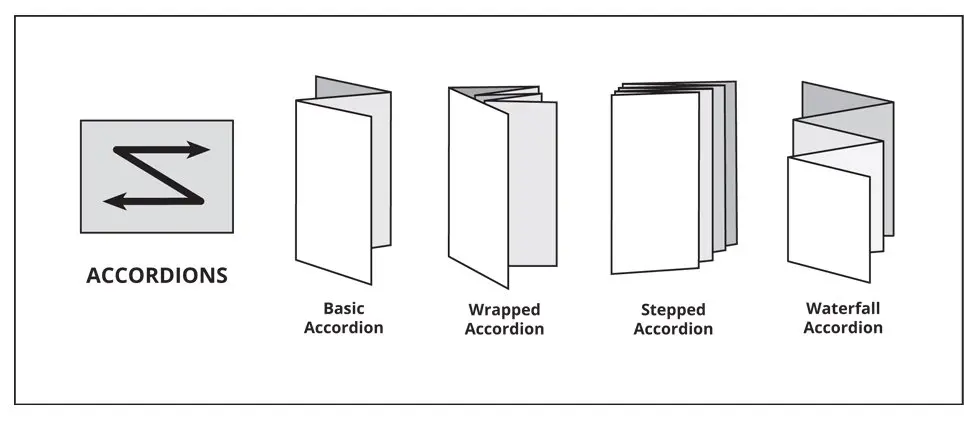
Z-Fold (Accordion): Maximum Information
The Z-fold folds a sheet in an alternating Z pattern, creating panels that expand like an accordion. The piece can lie flat or stand upright on a table.
Panel count: 6 panels
Best for: Step-by-step guides, maps, process documentation, and timelines that benefit from a continuous horizontal reading experience.
Gate Fold: The Reveal Experience
A gate fold has two outer panels that open from the center like gates, revealing a larger inner panel. It is the most impactful fold type - and the most expensive.
Best for: High-impact reveals - product launches, luxury real estate, invitations, and annual reports where the opening experience is part of the brand statement.
Cost consideration: Gate folds require more paper and more complex bindery work. Budget approximately 20-35% more than a standard tri-fold at equivalent quantities.
Choosing the Right Format
| If you need... | Choose |
|---|---|
| Standard rack distribution | Tri-fold |
| Premium look, few content sections | Bi-fold |
| Step-by-step or timeline content | Z-fold / Accordion |
| High-impact reveal / luxury brand | Gate fold |
File Setup for Folded Pieces
Every fold type has specific template requirements. The panel that folds inward must be slightly narrower (typically 1/16 inch per inward panel) to prevent buckling. Download the correct template from Super Cheap Cards before designing to avoid layout revisions later.
Ready to print your brochure? Browse our brochure printing options or call (512) 573-1977.